Grand Bazaar Istanbul — Guided Small-Group Walking Tour
4,000 shops, 61 covered streets and 550 years of continuous trading — the Grand Bazaar is completely overwhelming without a plan. A licensed guide cuts an hour of aimless wandering down to a tight 45-minute route.
Is the Grand Bazaar worth visiting, and how do you avoid being overcharged?
The Grand Bazaar is free to enter, open Monday to Saturday roughly 09:00–19:00 and closed on Sundays. It is worth visiting for the 15th-century bedesten core, the goldsmiths' lanes and Turkish craftsmanship — not for souvenirs. Prices are negotiable: expect to settle 30–50% below the first quote, and always compare three stalls first.
- Entrance fee: Free
- Opening hours: Mon–Sat 09:00–19:00 · closed Sundays and public holidays
- Size: 61 covered streets, ~4,000 shops, 22 gates
- Time needed: 1–2 hours guided, longer if shopping seriously
- Bargaining: Expect 30–50% below the opening quote
- Best buys: Gold, hand-knotted rugs, copper, İznik-style ceramics
- Best pairing: Spice Bazaar + Süleymaniye, 10 minutes downhill
Insider tips
- Start at the İç Bedesten, the oldest vaulted core — antique dealers there set the honest ceiling price for the whole bazaar.
- Ask for the price in Turkish lira; quotes converted to euros usually carry a 15–20% tourist margin.
- Card payments sometimes attract a “commission”; asking to pay cash frequently reopens the negotiation.
Common mistakes
- Buying at the first stall inside the Nuruosmaniye gate — the most expensive frontage in the bazaar.
- Planning a Sunday visit; the whole complex is shut.
- Accepting “this is my last price” on the first pass. It rarely is.
What the Grand Bazaar actually is
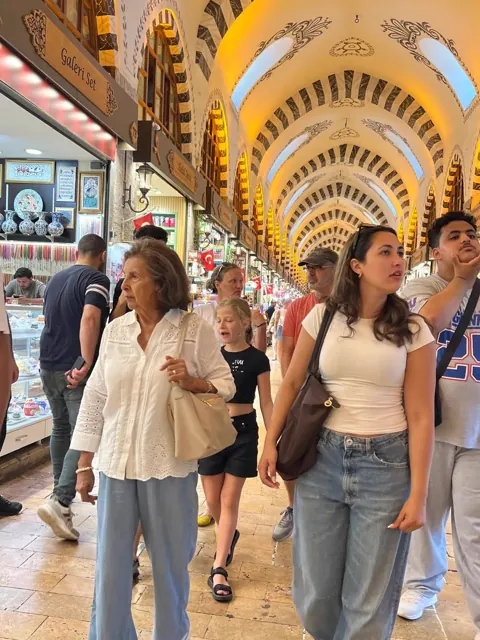
The Grand Bazaar (Kapalıçarşı, "Covered Market") is a walled 30,700 m² covered market built by Sultan Mehmed II in 1461 and continuously expanded until the mid-17th century. It contains around 4,000 shops laid out along 61 covered streets, plus two enclosed treasuries (Cevahir Bedesten and Sandal Bedesten) that historically held the highest-value goods. It draws 250,000–400,000 visitors per day, making it one of the most-visited landmarks on Earth.
A guide is worth it here for orientation, not for shopping — the layout has changed piecemeal for 550 years and there is no logical grid. Five minutes with a guide at Nuruosmaniye Gate makes the difference between finding what you want and buying a random keychain at 3× the price out of exhaustion.
Opening hours, closed days and best time to go
The Grand Bazaar is open Monday to Saturday, 09:00–19:00. It is closed on Sundays and on public holidays including the two Eids. The Spice Bazaar (Mısır Çarşısı), 15 minutes downhill on foot, keeps the same hours plus a limited Sunday morning schedule. Both bazaars fill with cruise-ship day-trippers between 11:00 and 15:00 — early morning and late afternoon are noticeably calmer.
Frequently asked questions
What are Grand Bazaar opening hours?
The Grand Bazaar in Istanbul is open Monday to Saturday 09:00–19:00. It is closed on Sundays and during the two annual Eid holidays. Shop-by-shop hours vary — the outer perimeter and gate corridors open earliest and close latest.
Is the Grand Bazaar closed on Sunday?
Yes, the Grand Bazaar is fully closed on Sundays. If you're in Istanbul on a Sunday, the Arasta Bazaar behind the Blue Mosque and the Sunday antique market at Feriköy are the practical alternatives. The Spice Bazaar (Mısır Çarşısı) opens with reduced hours on Sundays.
What is worth buying at the Grand Bazaar?
The categories the Grand Bazaar still does genuinely well are: hand-woven kilim and cicim rugs (Cevahir Bedesten and around Takkeciler Sokak), gold and silver jewellery by the gram (Kalpakçılar Caddesi — the main covered spine), leather jackets (Perdahçılar), copper and brass, and quality Turkish delight and Turkish coffee at Hafız Mustafa or Ali Muhiddin Hacı Bekir off the Spice Bazaar side. Cheap "I ♥ Istanbul" T-shirts are marked up 200–400% versus street shops in Beyoğlu.
Do you bargain at the Grand Bazaar?
Yes, bargaining is expected on rugs, jewellery, leather and ceramics — start at roughly 40–50% of the first quoted price and settle around 60–70%. It is not done on fixed-price food shops (Turkish delight, spices sold by the kilo, coffee) or on branded chain shops inside the bazaar. Always walk away at least once — the counter-offer is where the real price lives.
How long do you need at the Grand Bazaar?
Plan 45–60 minutes for a guided orientation walk that shows the main axis, the two bedestens and the pattern of shopkeepers by trade. Add another 60–90 minutes if you actually plan to shop for a rug or negotiate jewellery.
More Istanbul landmark guides
Moments from our tours